What the Product Evidence Lab test demonstrated
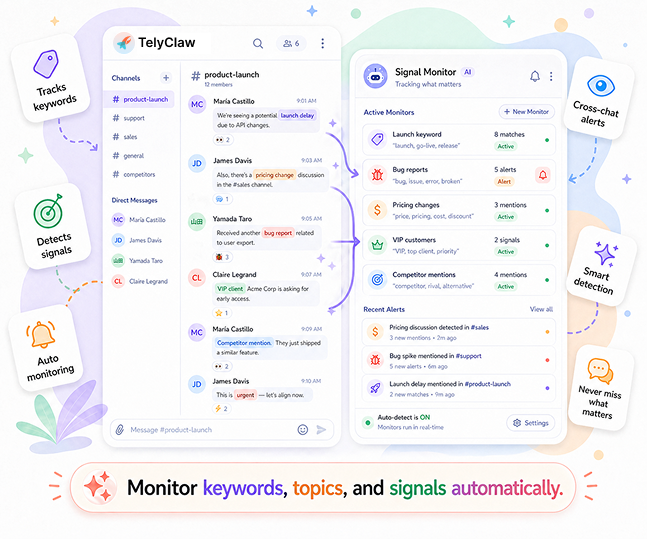
In the recorded Signal Filter test, TelyClaw returned a review organized by active, earlier, and prior-day messages, while excluding messages it categorized as advertisements or reaction bait. This supports a bounded workflow: reduce noise, extract the claim being made, preserve the original message, and send important items to a human verification queue. It does not establish that a token is legitimate, accurately priced, or likely to rise.
Treat every market claim as unverified
Labels such as official update, listing, airdrop, partnership, whale activity, or alpha are descriptions of what a message claims. They are not proof. A reviewer should open the named organization's independently located website or account, compare the exact contract address, inspect the destination domain, and avoid using a forwarded link as the only source.
Use separate queues for relevance and risk
Relevance and safety are different questions. A message can be relevant but fraudulent, or repetitive but legitimate. Keep separate queues for watchlist mentions, claimed official announcements, suspicious links or impersonation, repeated promotion, and unresolved items. Conservative labels such as review required are safer than automated buy, sell, safe, or scam conclusions.
Keep a human verification checkpoint
Before clicking, connecting a wallet, transferring funds, or trading, verify the claim outside the Telegram message and apply your own security and investment process. U.S. regulators warn that social-media tips, group chats, promised profits, and sudden token hype are common elements of fraud and pump-and-dump schemes.
What TelyClaw can support
TelyClaw's summary, filtering, and monitoring interface is designed to help organize high-volume chat review. Its Product Evidence Lab includes a passed Signal Filter execution on August 26, 2026 (TC-005 / EX-005 / EV-005) in the Windows v0.20 build. This is not a measured spam-detection rate, trading-accuracy score, return, loss-prevention rate, or time-to-market advantage. Check the current build before relying on a workflow.